



 any owners don’t decide to sell—they notice it, often in a season that felt harder than the last, in a milestone birthday or in an unsolicited email that makes them wonder what the business is actually worth. The decision arrives quietly. But what separates the owners who get a premium outcome when selling their business is what they do in the months and even years before that moment, not after it.
The landscape of the pet resort industry has shifted dramatically over the last decade. Private-equity-backed consolidators, sophisticated family offices and highly capitalized individuals are actively acquiring well-run pet businesses. However, a significant gap often exists between what an owner believes their business is worth and what the market will actually pay. This discrepancy occurs because owners frequently go to market without stepping behind the buyer’s lens to understand how the buyer actually underwrites risk, evaluates business metrics or values profitability.
- Planning Well Ahead: Clean financials, reduced owner dependency and regulatory safety nets cannot be fabricated in a few frantic weeks; they must be built deliberately over time.
- Understanding the Buyer’s Perspective: Acquirers do not look at your business through an emotional lens; they look at it as a risk-managed portfolio, evaluating how seamlessly the operation will function after you step away.
- Targeting Key Value Drivers: Buyers build their offers around specific benchmarks of business attractiveness, operational efficiency and scalable valuation metrics.

To maximize your value and transition from an operator to a true shareholder, owners should:
- Empower a General Manager (GM): If a GM is already on your team, ensure they are truly empowered to run the facility’s day-to-day workflow. If you do not have a GM in place, move aggressively to hire a high-quality operator as soon as possible. Elevating or hiring this leader 12+ months before a sale ensures a stable, turnkey management layer that remains post transaction.
- Minimize Owner Hours and Ensure Replaceability: Your active time spent on the business should ideally be reduced to 10 hours per week or less leading up to a sale. Furthermore, your remaining operational focus must be entirely “replaceable”—meaning the incoming buyer can absorb your responsibilities within their existing corporate infrastructure.
- Target Strategic Labor Metrics: Labor is your largest line item. Buyers want labor optimized prior to buying—not after—and will closely analyze payroll-to-revenue ratios. Clean up scheduling models to get your labor expense below 45% (ideally hitting a 35% target) of total revenue.


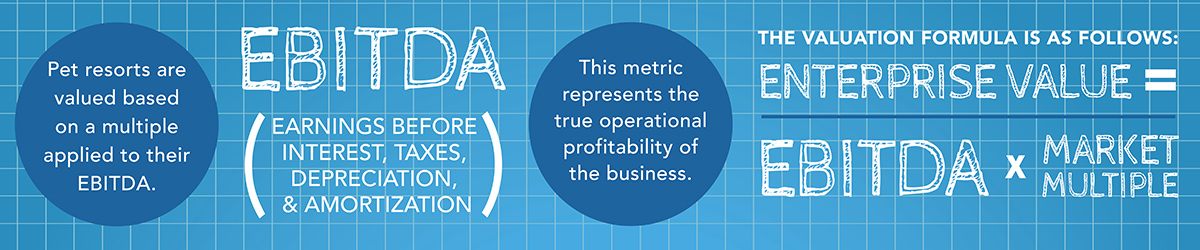
To maximize your pet resort’s EBITDA, be sure to:
- Professionalize the Books: If you run your financials on a cash basis or use informal bookkeeping, transition immediately to an accountant. Buyers require clean, clear and consistent financial statements.
- Identify Defensible Add-Backs: Work with your accountant to track and document personal or discretionary expenses run through the business, such as owner compensation above market rate, personal vehicles and non-recurring capital investments. Professional buyers look for this documentation for the last three years as a strict baseline requirement during underwriting. Every add-back must be supported by a clear paper trail; aggressive or undocumented adjustments instantly erode buyer trust during due diligence.
It’s essential to establish a sound legal foundation before going to market, which can be accomplished through:
- Audit Zoning and Permits: Ensure your property is explicitly and correctly zoned for pet care usage. If your facility operates under a legal non-conforming status (“grandfathered” zoning), retain a land-use attorney or municipal consultant to investigate exactly what happens to that status upon a change of ownership. Verify that all municipal and state business licenses and health department certifications are current.
- If You Lease Your Facility: Review assignment clauses carefully; most require formal landlord consent for a transfer of ownership. Ensure your lease has at least three to five years remaining, preferably with several long-term renewal options. If you have a good relationship with your landlord, open a dialogue early regarding a potential sale.
- If You Own the Real Estate: Establish a clear boundary between the property asset and the business asset. Obtain an independent, professional property valuation. Crucially, ensure your business books reflect a fair market lease rate so a buyer can accurately evaluate the resort’s true operational profitability.



- Execute a Prioritized Facility Audit: It is rarely realistic to fix every cosmetic blemish. Instead, conduct a comprehensive review of your facility and build a list of all aesthetic and structural issues. Cost and prioritize addressing high-impact items like damaged epoxy flooring, rusted kennel latches and worn play-yard turf.
- Review Lease CapEx Responsibilities: Before spending money on major structural elements, review your commercial lease. The landlord may bear financial responsibility for major capital expenditures, such as commercial HVAC systems and roofing repairs.
- Enhance Curb Appeal: The physical entry experience should signal a premium operation. A clean, modern and completely odor-free lobby builds immediate buyer confidence.

To lock in that talk-of-the-town, 5-star standing, resort owners will need to:
- Drive Consistent Google Reviews: A strong digital reputation is one of the first metrics an acquisition team checks. A Google Rating of 4.5+ stars, with frequent recent positive reviews, is important to a buyer. Implement automated systems that prompt happy clients for reviews immediately following checkout.
- Demonstrate Active Moderation: Ensure your management team professionally and calmly responds to both glowing reviews and any negative feedback. This proves to an incoming investor that your client base is actively managed and highly insulated from reputational crises.
To hypothetically answer that question as a buyer, you might:
- Highlight Underutilized Capacity: If your facility hits peak capacity only during major holidays, detail the clear growth runway available by expanding off-peak daycare programs, midday enrichment activities or targeted midweek training packages.
- Identify Scalable Service Lines: Outline how an unutilized room or outdoor area could be converted into a high-margin grooming salon, a specialized feline boarding wing or a retail space.
- Demonstrate the Impact of Pricing Power: Prove the pricing elasticity of your local market by presenting a clear track record of historical rate increases. Showing a buyer that the facility seamlessly handles a predictable 3-5% annual inflationary adjustment without losing clientele highlights immediate top-line leverage. Additionally, outline the potential to deploy high-margin, value-packed activity bundles, which allows an incoming owner to rapidly increase average client spend without adding to physical overhead.
- Identify Untapped Marketing Channels: Present a blueprint of underutilized or uninitiated marketing avenues that a buyer could immediately activate to drive customer acquisition. Documenting the ready-to-launch upside of targeted digital advertising campaigns, automated email marketing nurture tracks or local strategic partnerships provides a corporate acquirer with an immediate plug-and-play growth playbook.

By treating your facility as an investment portfolio months, and even years, before you intend to exit, you ensure that when the right moment arrives, you are completely in control of the narrative, the process and your legacy. The time invested in professionalizing your operation today is quite simply the highest-returning work you can perform for your business.